

As the demand for clean-label preservatives intensifies, alpha terpinene (1-isopropyl-4-methyl-1,3-cyclohexadiene) has emerged as a critical monoterpene in industrial formulations. Found naturally in tea tree, cardamom, and marjoram oils, this conjugated diene offers potent antimicrobial properties alongside a characteristic citrus note. For industrial formulators and R&D chemists, understanding the technical specifications—such as alpha terpinene density and volatility—is essential for integrating this compound into stable food, fragrance, and cleaning products. Linxingpinechem provides high-purity isolation of this terpene, ensuring consistent performance in reducing microbial loads while maintaining olfactory integrity.
Physicochemical Characterization and Analytical Quality Control
Defining the physical parameters of alpha terpinene is the first step toward successful inclusion in emulsions and solvent systems. Its conjugated structure not only dictates its reactivity but also serves as a primary marker for quality assessment through specific chemical interactions.
Physicochemical Parameters: Melting Point, Boiling Point, and Density
Precise control over processing temperatures relies on accurate data regarding phase changes. The alpha terpinene melting point is approximately -31°C (< 25°C), ensuring it remains liquid under standard processing conditions. However, in cold-process manufacturing, viscosity changes near this threshold can affect flow rates.
Volatility is another critical factor. The alpha terpinene boiling point ranges between 173°C and 175°C at standard pressure (760 mmHg). This relatively high boiling range allows it to function as a middle-to-top note in fragrance hierarchies, evaporating slower than lighter monoterpenes like limonene. Formulators must account for this during heat-intensive encapsulation processes to prevent premature loss.
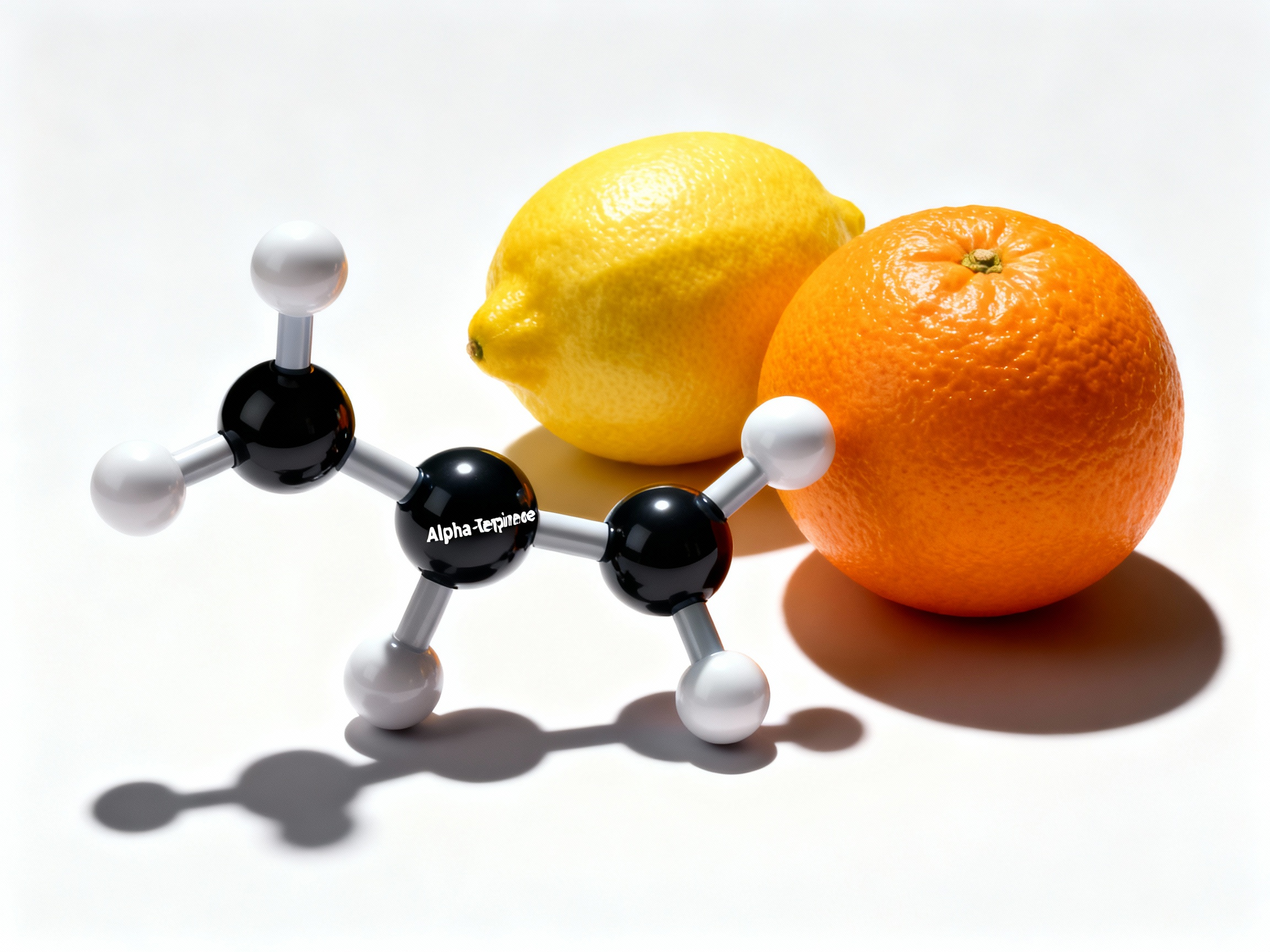
Density plays a vital role in separation kinetics for oil-in-water emulsions. Alpha terpinene density is typically recorded at 0.837 g/mL (at 25°C). Variations in specific gravity can indicate oxidation or adulteration.
Table 1: Standard Physicochemical Profile of Alpha-Terpinene
|
Property |
Value Range |
Relevance |
|
Boiling Point |
173°C – 175°C |
Determines evaporation rate in open systems. |
|
Density (25°C) |
0.833 – 0.840 g/mL |
Critical for weight-to-volume conversions. |
|
Refractive Index |
1.475 – 1.480 |
Quick purity indicator for incoming raw materials. |
|
Flash Point |
~47°C – 50°C |
Safety parameter for storage and transport. |
Quantitative Analysis Using Maleic Anhydride
The structural integrity of alpha terpinene is unique due to its conjugated 1,3-diene system. This feature allows for a specific reaction between alpha terpinene and maleic anhydride via the Diels-Alder mechanism. Unlike non-conjugated isomers (such as gamma-terpinene), alpha-terpinene forms a crystalline adduct with maleic anhydride.
This reaction is utilized in the “Diene Value” determination, a quantitative method to assess purity. High-performance liquid chromatography (HPLC) or gas chromatography (GC) are standard, but the maleic anhydride adduct formation remains a classic verification of the conjugated system. Monitoring this reactivity is also crucial for stability; oxidation leads to the formation of p-cymene and ascaridole (a peroxide), which reduces the diene value and increases sensitization risks.
Antimicrobial Efficacy and Functional Industrial Applications
Beyond its chemical attributes, alpha terpinene effects on microbial survival make it a valuable tool for preservation. Its lipophilic nature allows it to interact with biological membranes, offering a natural alternative to synthetic bacteriostats.
Mechanisms of Antimicrobial Action
The antimicrobial power of alpha terpinene stems from its ability to partition into the lipid bilayer of bacterial cell membranes. Research indicates that it disrupts membrane integrity, leading to:
1. Increased Permeability: Leakage of essential intracellular ions (potassium and phosphate).
2. Respiration Inhibition: Disruption of the proton motive force, halting ATP production.
3. Lysis: At higher concentrations, it causes structural collapse of Gram-positive and Gram-negative bacteria, including Escherichia coli and Staphylococcus aureus.

These alpha terpinene effects are concentration-dependent. In industrial cleaning, it acts synergistically with surfactants to penetrate biofilms, making it effective for heavy-duty degreasing where biological sanitation is also required.
Formulating for Flavor, Fragrance, and Safety
In the flavor and fragrance industry, alpha terpinene is prized for its woody, lemony, and spicy citrus note. It functions as a flavor enhancer in savory blends and a freshness booster in oral care products. However, regulatory compliance is paramount.
FEMA GRAS: Designated as Generally Recognized As Safe (FEMA 3558) for flavor use.
Sensitization: Due to its susceptibility to autoxidation, formulations must include antioxidants (like BHT or tocopherols) to prevent the formation of sensitizing peroxides.
Clean Label: It supports “free-from” claims, replacing synthetic solvents in green cleaning products while providing a pleasant olfactory profile.
Linxingpinechem Alpha-Terpinene Product Specifications
Linxingpinechem specializes in the extraction and refinement of high-purity Alpha-Terpinene, catering to B2B clients in the flavor, fragrance, and pharmaceutical sectors. Our manufacturing process ensures minimal isomer presence and controlled oxidation levels, delivering a stable raw material for sensitive formulations.
Product Highlights:
High Purity: Rigorous distillation achieves purity levels suitable for premium Fragrance Grade (FG) and Flavor applications.
Consistent Profile: Standardized alpha terpinene density and refractive index batch-to-batch.
Supply Chain Stability: Sourced from sustainable forestry byproducts, ensuring long-term availability.
Regulatory Support: Full documentation available, including REACH compliance and IFRA conformity statements.
Conclusion
Integrate Linxingpinechem Alpha-Terpinene into your product lines to leverage its dual benefits of antimicrobial protection and functional aroma. Contact our technical team today to request a sample or discuss bulk specifications tailored to your manufacturing needs.