

Gum turpentine occupies a unique position in the global market, straddling the line between a raw agricultural harvest and a refined industrial solvent. For procurement managers and supply chain analysts, understanding this regulatory duality is essential for optimizing costs. While the harvesting of turpentine gum is legally protected under agricultural tax frameworks in regions like the United States, the downstream product is traded as a complex chemical commodity. This article explores how producers leverage these exemptions to offset the labor-intensive extraction process while capitalizing on the premium value of pure gum spirit turpentine in international trade.
Agricultural Tax Framework and Production Economics
The economic viability of natural pine tapping relies heavily on specific tax treatments that categorize resin extraction as farming rather than industrial manufacturing. This distinction allows producers to mitigate the high operational costs associated with manual labor.
Harvesting Classification and Tax Incentives
In jurisdictions with significant forestry sectors, such as Georgia, USA, the collection of oleoresin is legally defined as an agricultural pursuit. Legislation like the Georgia Agriculture Tax Exemption (GATE) program permits producers to purchase harvesting equipment, such as tapping tools, cups, and apron gutters, tax-free. This exemption is critical because the initial “crude gum” is not yet a manufactured chemical but a crop. For example, under specific revenue rulings, machinery used exclusively for collecting turpentine gum qualifies for sales tax immunity, reducing capital expenditure by approximately 6-8%. This regulatory relief acknowledges that the raw material, often compared to the historical Georgia pine gum spirits of turpentine standard, requires the same cultivation risks as traditional food crops.

Labor-Intensive Extraction and Cost Dynamics
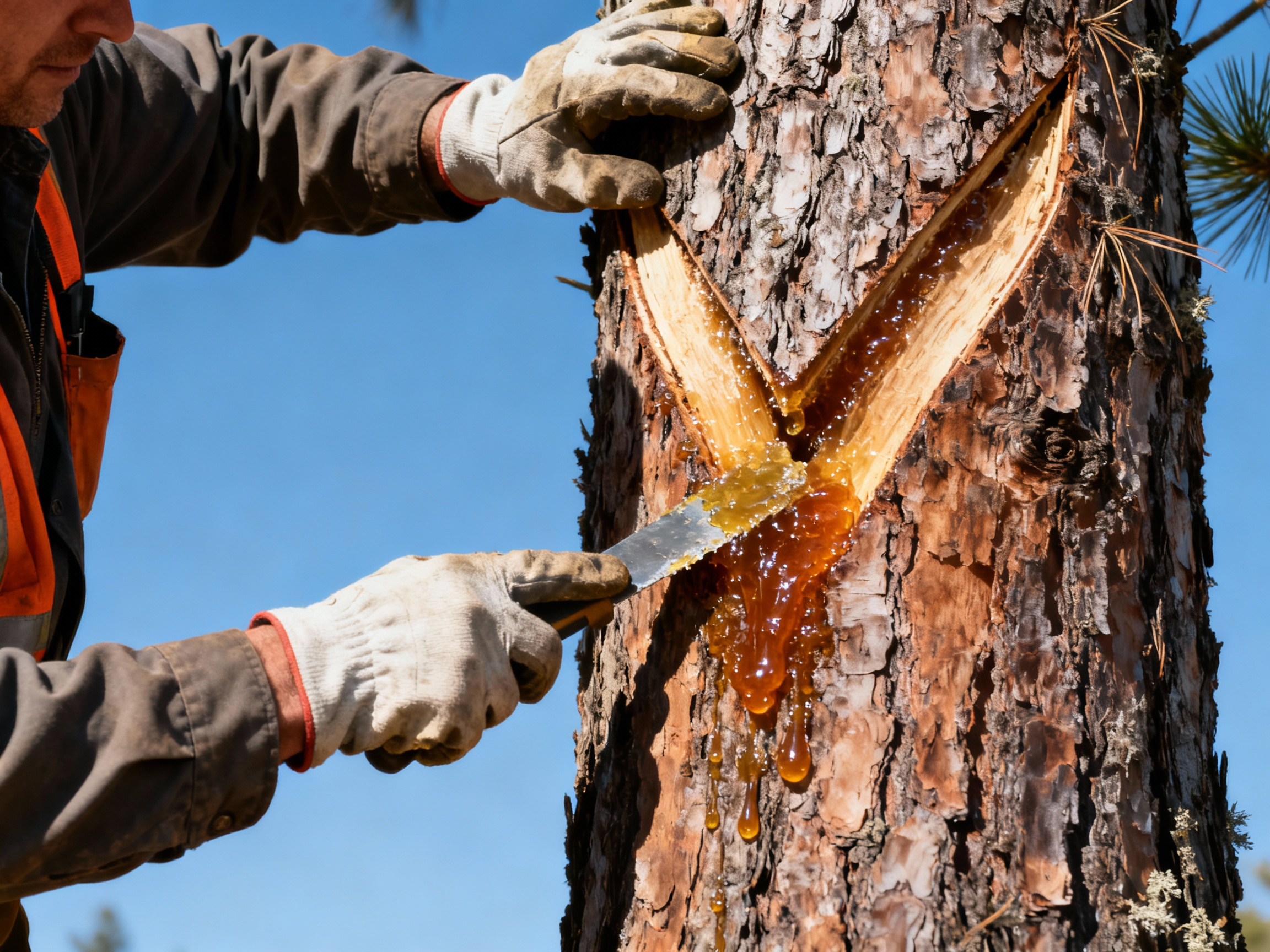
Unlike sulfate turpentine, which is a byproduct of automated paper pulping, natural turpentine requires manual incision of living trees. Industry data indicates that labor accounts for nearly 60% of the total production cost for gum spirits. A single worker typically tends to 800–1,000 trees per day, making the supply chain highly sensitive to wage fluctuations and seasonal labor availability. Tax exemptions help stabilize these costs, ensuring that the base price of pure gum spirit turpentine remains competitive despite the inherent inefficiencies of manual harvesting. Without these agricultural protections, the price floor for high-purity gum spirits would likely rise by 15-20%, disrupting supply for downstream fractionators.
Global Trade Standards and Industrial Valorization
Once the resin enters the international market, it transitions from an agricultural crop to a strictly regulated chemical commodity, governed by distinct Harmonized System (HS) codes and purity benchmarks.
Harmonized System Codes and Purity Standards
In global trade, gum turpentine is classified under HS Code 3805.10, distinguishing it from wood or sulfate turpentine . This classification is not merely administrative; it signals a superior chemical profile. Gum turpentine typically commands a price premium of $1.00–$1.50 per kilogram over industrial-grade alternatives due to its lack of sulfur contaminants. Procurement officers rely on these codes to ensure they are purchasing material suitable for sensitive applications. For instance, while historical references mention gum spirits of turpentine for health remedies, modern pharmaceutical buyers utilize strictly classified HS 3805.10 imports to synthesize camphor and menthol, requiring purity levels that industrial byproducts cannot consistently provide.
Fractionation Value Chain and Market Trends
The true industrial value of turpentine lies in fractionation. Statistics show that over 75% of global exports are fractionated into alpha-pinene and beta-pinene rather than used as direct solvents. High-quality natural turpentine yields approximately 75-80% alpha-pinene, a crucial precursor for synthetic flavors and fragrances. Converting raw spirits into these derivatives increases the material’s market value by 300-500%. Consequently, major exporters like China and Brazil are shifting focus from exporting raw crude to processing deep-refined derivatives, driven by a 4.5% annual growth in demand for bio-based renewable chemicals in the EU and North American markets.
Linxingpinechem Premium Pine Chemical Solutions
Linxingpinechem specializes in the deep processing of pine chemical resources, delivering high-purity derivatives that meet rigorous global standards. Our integrated production facilities in Guangdong maximize the potential of raw gum materials through advanced fractionation technologies.
High-Purity Fractionation: We operate production units with an annual capacity of 2,000 tons for both alpha-pinene and beta-pinene, ensuring consistent supply for fragrance and pharmaceutical intermediates.
Comprehensive Derivative Portfolio: Beyond basic spirits, our catalog includes Terpineol, Longifolene, and Paracymene, designed for specialized industrial applications ranging from coatings to electronics.
Quality Assurance: Adhering to strict management systems, our “Super Grade” Gum Turpentine guarantees the chemical consistency required by top-tier international buyers.
Conclusion: By bridging the gap between raw agricultural sourcing and advanced chemical synthesis, Linxingpinechem provides the reliability your supply chain demands.
Contact our trade compliance team today to secure a consistent supply of high-purity pine derivatives tailored to your specific industrial requirements.