

When our formulators and chemical engineers assess raw materials for manufacturing workflows, tracing component origins stands as a vital step toward verifying product authenticity. Within specialty-chemical and fragrance circles, one persistent debate continues: whether industrial solvents and aromatic intermediates deserve valid classification as natural ingredients. As a fundamental feedstock spanning numerous manufacturing segments, turpentine frequently sits at the heart of this ongoing classification discussion.
To draw reliable conclusions on this topic, we examine the full end-to-end lifecycle of these substances — starting from responsibly managed sustainable forests and concluding inside sophisticated chemical laboratories. When we build a solid understanding of how crude pine resin goes through controlled distillation and multi-stage refinement, we are well-positioned to deploy natural turpentine products to satisfy market demand for plant-derived ingredients, while preserving industrial-grade performance and batch-to-batch stability. The complete transformation journey, stretching from pine timber to high-value specialized chemical intermediates, reflects a supply chain largely built upon botanical raw-material sourcing.
The Botanical Origins of Pine Chemistry
At its core, pure gum turpentine is fundamentally a natural substance, sourced directly from living pine trees. The process begins with tapping, a sustainable agricultural method where harvesters carefully collect crude oleoresin from the bark of specific pine species. This raw, sticky resin acts as the tree’s natural defense mechanism, and its collection does not require the harvesting of the timber itself, allowing the forest ecosystem to continue thriving. Once collected, this crude oleoresin undergoes a straightforward physical separation process known as steam distillation.
This traditional extraction method separates the solid gum rosin from the volatile liquid fraction, which is the pure gum turpentine. Because the primary extraction involves only heat and steam rather than complex synthetic chemical synthesis, the resulting liquid retains its authentic botanical classification. We prioritize sourcing our raw oleoresin from our local, high-yield production areas to maintain strict quality control over this initial natural phase.
Processing Turpentine Products for Industrial Application
While raw turpentine is undeniably natural, its value in modern manufacturing lies in the sophisticated refinement processes that isolate specific chemical compounds. The raw liquid contains a complex mixture of terpenes, primarily alpha-pinene and beta-pinene, which serve as highly versatile building blocks for further chemical modification. Through advanced, PLC-controlled fractional distillation and specialized chemical reactions, we transform these basic terpenes into highly purified intermediates required by demanding industries.
Even as these materials undergo structural changes to enhance their stability, solubility, or olfactory profile, their carbon framework remains derived from the initial, sustainably harvested pine resin. This distinction is crucial for manufacturers formulating goods that require verifiable botanical origins. By starting with a naturally occurring, renewable resource, our refined chemical outputs offer a distinct advantage over heavily petroleum-derived alternatives that dominate certain industrial supply chains.
Technical Specifications of Highly Refined Paramenthane
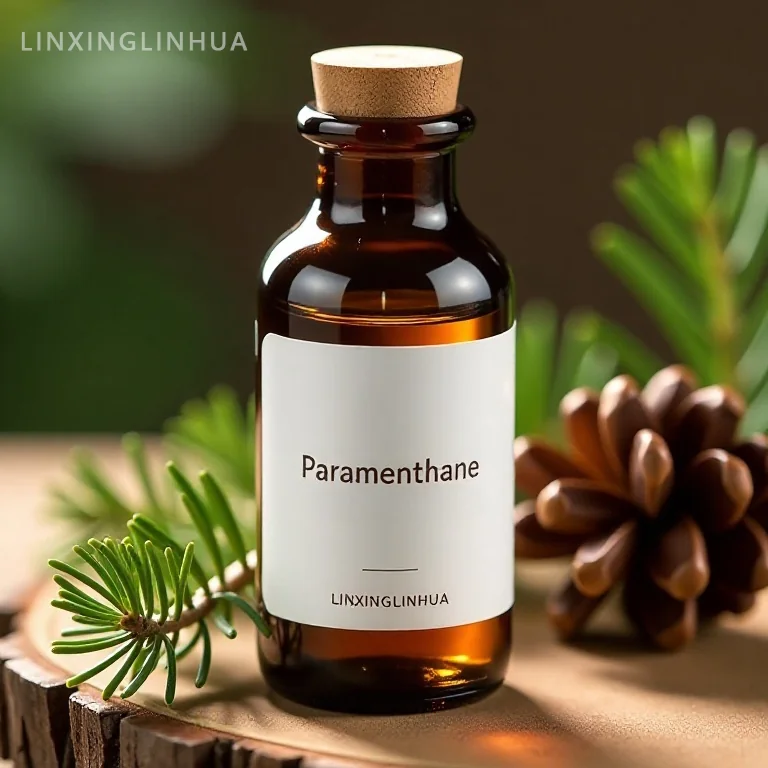
One of the most valuable intermediates derived from our natural turpentine processing is Paramenthane. Through a series of intricate, highly controlled chemical reactions, we convert dipentene—a byproduct of our essential oil distillation—into this versatile, transparent, and colorless oily liquid. This material is highly sought after across multiple sectors, functioning as a vital component in the manufacture of organic peroxide initiators, a reliable precursor for hydrogen peroxide, and a critical intermediate in the creation of complex synthetic perfumes.
To support consistent performance for our commercial partners, we apply rigorous technical standards during production. Our output typically maintains a purity level of ≥ 95% via gas chromatography, alongside a specified relative density (D20⁴) tolerance between 0.79 and 0.82. We also monitor the refractive index (N20) and aim to keep it within the range of 1.437 to 1.460, while controlling P-cymene content to ≤ 0.5% and targeting an Iodine value (g/100g) of ≤ 0.8.
Preserving Integrity Through the Supply Chain
Maintaining the quality and stability of refined botanical derivatives calls for careful handling protocols beyond the extraction and synthesis stages. Organic chemical intermediates, though natural in origin, can be sensitive to temperature, light, and air exposure. We apply robust packaging and storage practices to help preserve molecular integrity until materials reach the formulation floor.
We recommend storing these liquids in cool, dry, well-ventilated areas, preferably shielded from direct sunlight. During transport, applying appropriate measures against moisture ingress and temperature swings helps minimize the risk of degradation or unwanted polymerization. By treating these pine derivatives with the same care as pharmaceutical ingredients, manufacturers can better protect the functional and aromatic properties that underpin their value.
Integrating Botanical Chemistry into Future Formulations
The chemical industry continues shifting toward renewable, plant-based raw materials amid tightening regulatory requirements and evolving consumer preferences. Navigating this industry transition often calls for collaboration with manufacturers possessing deep practical expertise in botanical extraction and chemical refinement. Gaining visibility into supply-chain origins supports formulators when evaluating labeling approaches, environmental footprint considerations, and long-term supply-chain reliability.
At Linxingpinechem, we bridge proven forestry practices and modern chemical engineering, supplying validated intermediates that help drive innovation across fragrance, solvent, and specialty-chemical markets. When you incorporate our carefully processed pine-derived materials within your manufacturing frameworks, your business can build a robust, high-performance foundation to advance next-generation product development.