

Paramenthane distinguishes itself as a premier solvent in industrial chemistry due to its fully saturated cyclic structure, which provides superior inertness compared to standard botanically derived terpenes. While terpenes serve as the renewable feedstock, their inherent double bonds can cause undesirable side reactions during organic peroxide synthesis. Paramenthane, being the hydrogenated derivative, eliminates these instability risks, functioning as a precise molecular weight regulator. This article details the chemical logic behind choosing saturated solvents over reactive precursors to ensure safety, yield, and purity in polymerization processes.
Transforming Reactive Terpenes into Inert Solvents
In the realm of industrial synthesis, the distinction between a raw feedstock and a precision solvent lies in chemical stability. While botanically derived terpenes (such as alpha-pinene or limonene extracted from pine gum) are excellent renewable starting materials, their utility as solvents is limited by their reactivity.
The Hydrogenation Mechanism for Stability
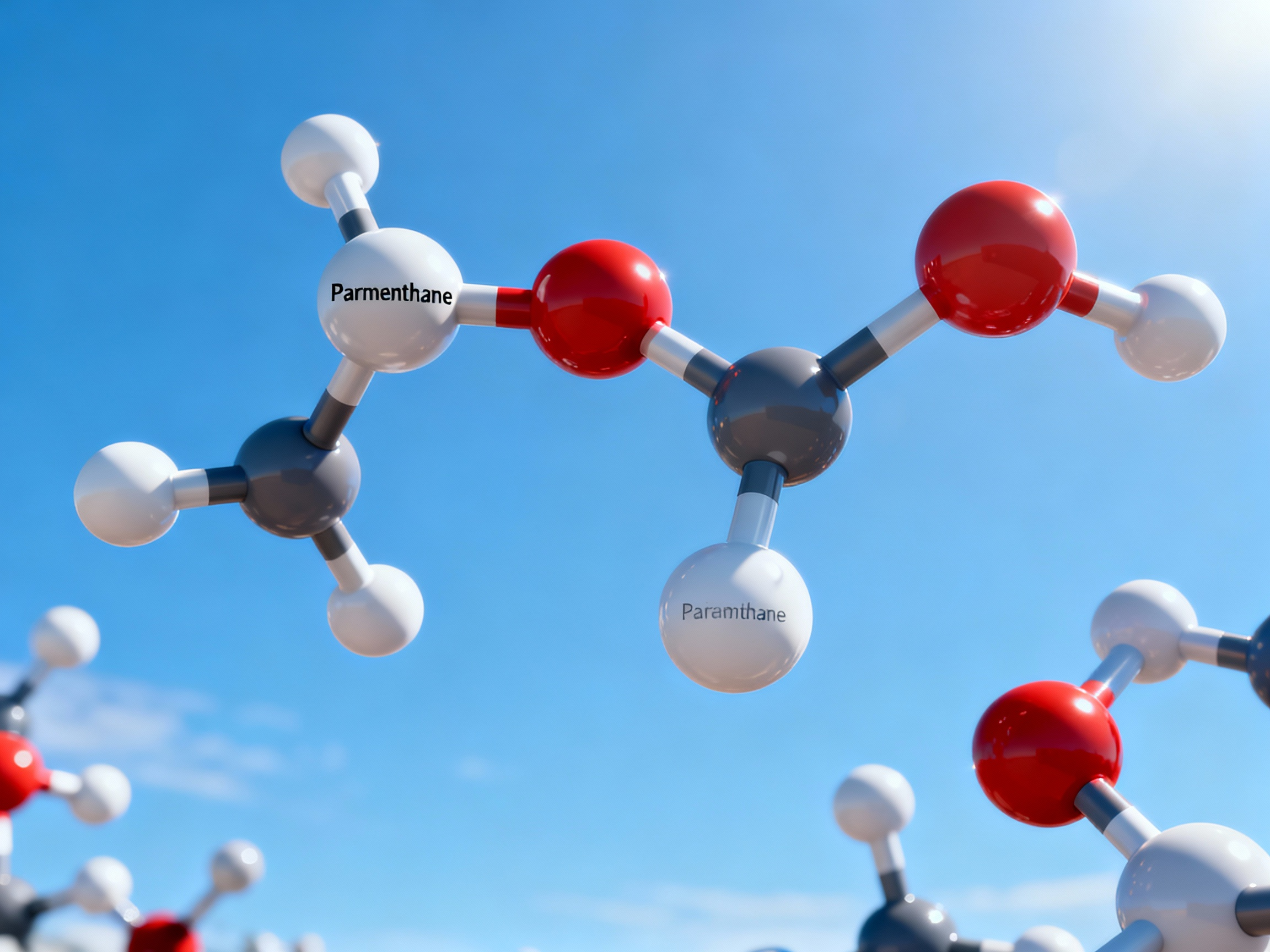
The primary difference between reactive terpenes and Paramenthane (p-Menthane) is the presence of carbon-carbon double bonds. Raw terpenes typically contain unsaturated bonds that are susceptible to oxidation and uncontrolled polymerization. Through catalytic hydrogenation, these double bonds are saturated to form a stable cyclohexane ring structure. This transformation converts a reactive industrial chemical intermediate into a chemically inert solvent. By removing the reactive sites, the solvent no longer competes with the reagents, ensuring that the thermodynamics of the intended reaction remain undisturbed. This saturation is critical for processes involving strong oxidizers, where an unsaturated solvent would pose significant safety hazards.
Impact on Reaction Kinetics and Purity
When discussing the botanical derived terpenes meaning in a solvent context, purity is paramount. Unreacted terpenes in a solvent mixture can act as radical scavengers, prematurely terminating chain reactions or forming unwanted by-products. In organic peroxide synthesis, the presence of p-Cymene or residual unsaturated terpenes can degrade the final assay purity. Paramenthane, with its saturated structure, does not scavenge free radicals unpredictably. This inertness allows for precise control over reaction kinetics, ensuring that the peroxide formation proceeds at the calculated rate without interference from solvent impurities.
Optimizing Polymerization with Molecular Weight Regulation
Beyond mere inertness, Paramenthane plays an active role in controlling polymer architecture. Unlike general botanically derived terpenes vs cannabis-derived terpenes discussions which focus on flavor profiles, the industrial focus here is on chain transfer mechanics in large-scale manufacturing.
Controlling Chain Transfer in Manufacturing
In polymerization catalysis, maintaining a narrow molecular weight distribution (PDI) is essential for consistent material properties. Paramenthane acts as an effective molecular weight regulator (chain transfer agent). It functions by donating a hydrogen atom to a growing polymer chain, terminating that specific chain’s growth while initiating a new one, all without stopping the overall polymerization process. This mechanism allows engineers to fine-tune the average molecular weight of polymers like styrene-butadiene rubber (SBR) or acrylonitrile butadiene styrene (ABS). Using a consistent, saturated solvent like Paramenthane ensures that batch-to-batch variations in polymer viscosity and strength are minimized.
Sustainable Industrial Chemical Intermediates
The shift towards bio-based solvents is often complicated by the cannabis derived terpenes vs botanical terpenes supply chain debate, yet for industrial scale, pine-derived Paramenthane offers superior reliability. As a biodegradable solvent produced from renewable pine chemicals, it aligns with Green Chemistry principles. It replaces traditional chlorinated or aromatic solvents which typically carry higher toxicity and disposal costs. By integrating Paramenthane into closed-loop recovery systems, manufacturers can achieve high solvent recovery rates due to its thermal stability, significantly reducing hazardous waste generation and operational costs in continuous flow manufacturing setups.
High-Performance Paramenthane from Linxingpinechem
Linxingpinechem specializes in the deep processing of turpentine to produce high-purity Paramenthane designed for demanding chemical synthesis applications. By strictly controlling the hydrogenation process, Linxingpinechem ensures a solvent that meets rigorous industrial standards for stability and low impurity profiles.
Key Technical Specifications:
Purity (GC): ≥ 95%
Appearance: Transparent and colorless oily liquid
Relative Density (d20/4): 0.79 – 0.82
Refractive Index (n20/D): 1.437 – 1.460
p-Cymene Content: ≤ 0.5%
Iodine Value: ≤ 0.8 g/100g
Product Highlights:
Low Impurity Profile: With p-Cymene levels kept strictly below 0.5%, this product minimizes the risk of side reactions in peroxide synthesis.
Consistent Supply Chain: Unlike the volatility seen in the cannabis-derived terpenes vs botanical terpenes market, Linxingpinechem leverages established pine gum supply chains to ensure multi-tonnage availability year-round.
Versatile Application: Ideal for use as a reaction medium for organic peroxides (specifically p-Menthane Hydroperoxide precursors) and as a stable carrier solvent.
Transition to high-purity Paramenthane today to enhance the safety and efficiency of your polymerization processes while meeting sustainability targets.