

To choose a Delta-3-Carene supplier, buyers should compare purity, batch COAs, testing methods, packaging, storage requirements, and delivery capability. When sourcing highly volatile monoterpenes, quality consistency is especially important when sourcing volatile monoterpenes. Procurement professionals tasked with securing these essential building blocks must look beyond basic availability and deeply evaluate the refinement processes of their supply chain partners. As global regulatory standards tighten and sustainability mandates increase across the flavor and fragrance industries, understanding the origin and processing history of these materials becomes critical. Among the most sought-after cyclic monoterpenes is delta 3 carene, a highly valuable compound isolated during the advanced processing of natural pine exudates. Identifying a manufacturing partner capable of consistently delivering this specific molecule at an industrial scale requires a rigorous, multifaceted assessment of their extraction technology, quality control protocols, and overall supply chain transparency.
The Distillation Standard for High-Purity Terpenes
Raw pine oleoresin contains volatile turpentine components, non-volatile rosin, moisture, and impurities introduced during collection and handling. To extract usable volatile fractions, the crude gum must undergo primary steam or vacuum distillation. Applications with stricter specifications may require additional refining and supporting product-grade or regulatory documentation. The resulting liquid must be further refined through rigorous rectification. Additional rectification may reduce selected volatile impurities, oxidation products, moisture, or color-forming components, depending on the feedstock. Buyers must also distinguish between derivatives sourced from kraft pulping (crude sulfate turpentine) and those from live tree tapping (gum turpentine), as the latter often requires less aggressive chemical deodorization. Buyers must demand clear, verifiable documentation detailing these rectification phases, as improperly refined material may affect odor, reaction performance, or stability in downstream applications.
Decoding the Molecular Specifications of Carene
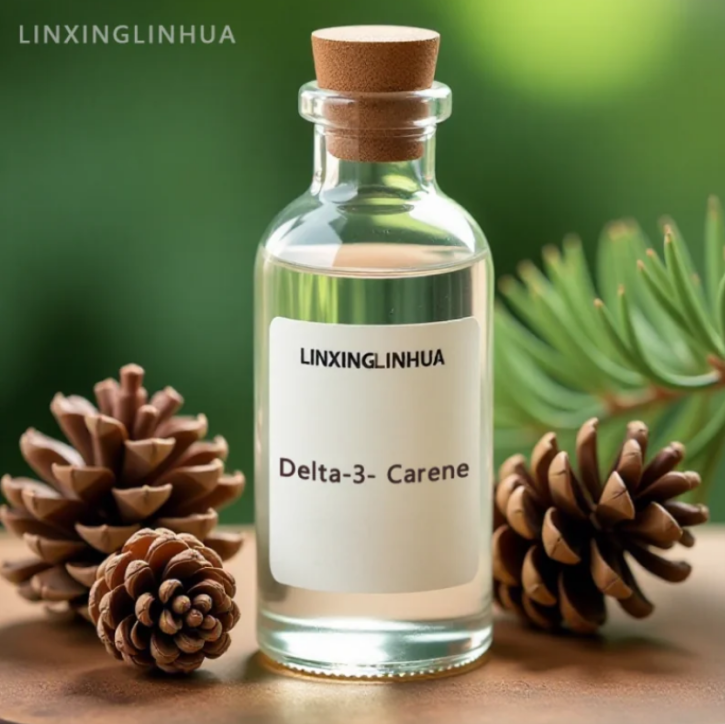
Assessing a supplier’s capability requires analyzing their exact chemical output. A critical component derived from this intensive refinement is the bicyclic monoterpene known scientifically as 3-carene. With the chemical formula C10H16 and a molecular weight of 136.23 g/mol, it presents as a colorless, mobile liquid characterized by a sweet, pungent, and distinctively pine-like aroma. It is officially registered under CAS NO. 13466-78-9. Its relatively narrow boiling range requires precise control during fractional distillation to achieve high-purity separation from other monoterpenes. Quality assurance laboratories must provide a Certificate of Analysis (COA) confirming specific physical parameters: a relative density (d_4^20) typically between 0.855 and 0.865, and a precise refractive index (n_D^20) ranging from 1.4640 to 1.4680. If a manufacturer cannot consistently meet these strict indices across multiple batches, buyers should further review the supplier’s fractionation capability and quality-control procedures.
Validating Gas Chromatography and Purity Metrics
Moving deeper into supplier evaluation, procurement teams must verify the analytical testing methods employed directly on the factory floor. The absolute purity of rectified oil of turpentine and its isolated fractions is entirely dependent on continuous, precise instrumental monitoring. Suppliers should use validated analytical methods, such as Gas Chromatography (GC), to confirm that each batch meets the agreed specification. For derivatives intended for complex synthetic chemistry—such as the catalytic conversion of carene into synthetic menthol or other advanced flavor intermediates—purity levels must frequently exceed industry thresholds of 90% or 95%. Strict GC testing ensures that competing monoterpene isomers, such as alpha-pinene, beta-pinene, or camphene, are kept within extremely tight tolerance limits. Sourcing managers should always formally request sample chromatograms alongside standard technical data sheets during the initial supplier auditing phase to guarantee technical competence and formulation safety.
Preserving Chemical Integrity Through Specialized Logistics
The physical transportation of bulk volatile hydrocarbons introduces severe logistical risks regarding chemical degradation. Monoterpenes are highly susceptible to rapid oxidation, thermal rearrangement, and unwanted polymerization when exposed to atmospheric oxygen, ultraviolet radiation, or elevated ambient temperatures. Consequently, evaluating a supplier’s specialized packaging infrastructure is an important part of supplier evaluation. Industrial-grade terpene derivatives must be hermetically sealed in heavy-duty, brand-new galvanized iron drums, typically standardized at a strict net weight of 175 kg or 180 kg. For larger global chemical shipments, specialized ISO tanks compliant with international hazardous material (hazmat) maritime regulations are frequently utilized. These specific containers prevent destructive light penetration and moisture ingress during prolonged ocean transit. Furthermore, advanced manufacturers implement a strict nitrogen-blanketing protocol during the filling stage, which actively displaces oxygen and preserves the chemical’s pristine state from the distillation column all the way to the buyer’s storage facility.
Aligning with Vertically Integrated Manufacturing Expertise
Ultimately, the most robust defense against market volatility and quality fluctuations is strategic supplier integration. Companies that rely on third-party brokers for crude raw materials frequently suffer from erratic pricing and inconsistent batch profiles. The optimal sourcing strategy involves partnering directly with manufacturers positioned at the source of the pine feedstock. A prime example of this operational excellence is Linxingpinechem, an enterprise that integrates sustainable forestry access with state-of-the-art fractional distillation technology. At Linxingpinechem, we manufacture Delta-3-Carene and other pine-derived chemicals with defined product specifications and order-to-after-sales support. Establishing long-term contracts with technologically advanced, vertically integrated facilities empowers buyers to maintain formulation integrity while optimizing their procurement budgets in a highly competitive chemical landscape.