

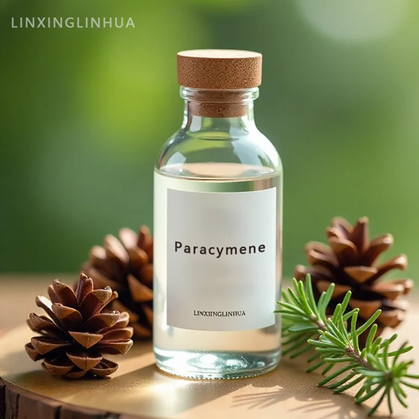
Paracymene, also known as p-cymene, is a terpene-derived aromatic compound used in fragrance, flavor, pharmaceutical, and chemical applications. Its production is closely connected to pine-derived feedstocks, including distilled turpentine oil and limonene- or dipentene-rich terpene fractions. Understanding how raw pine oleoresin is processed into these refined feedstocks can help buyers better evaluate Paracymene quality, production capability, and supplier reliability. This article explains the key stages from pine oleoresin refining and terpene separation to Paracymene synthesis, quality control, storage, and sourcing.
Pine-Derived Feedstocks for Paracymene Production
To understand the refinement process, one must first analyze the source material. Crude pine oleoresin is a viscous secretion collected from pine trees and contains both volatile turpentine components and non-volatile rosin, primarily from the Pinus genus. This natural exudate is not a singular substance, but a complex, semi-fluid mixture. It consists of a volatile liquid portion holding non-volatile solid resins in a stable suspension. The non-volatile solid fraction is composed of diterpene resin acids, mainly abietic acid (C20H30O2), which are isolated during processing as gum rosin. Crude oleoresin may contain bark particles, moisture, soil, and other impurities introduced during collection and handling. Due to its high viscosity, sticky physical state, and dense concentration of impurities, crude oleoresin cannot be utilized directly in precise industrial formulations or high-tech chemical synthesis without undergoing rigorous purification.
From Raw Pine Oleoresin to Distilled Turpentine
Converting crude pine gum into a highly volatile, industrial-grade solvent requires advanced thermodynamic separation. Manufacturers employ steam distillation or vacuum distillation techniques to isolate the volatile components from the non-volatile solid matrix. In this process, the crude gum is heated, and steam is introduced to lower the partial pressure of the volatile terpenes. The light monoterpenes vaporize and travel up the distillation column, leaving the heavy diterpene rosins behind as a non-volatile liquid residue. Once the vapors are cooled and condensed, they separate into an aqueous layer and a clear, organic liquid layer. This volatile organic liquid is what the chemical industry classifies as distilled turpentine. For applications with stricter specifications, additional refining may be used, while final suitability must be confirmed through product-grade and regulatory documentation.
Refining Terpene Fractions for Paracymene Synthesis
Refined distilled turpentine is a highly volatile, water-white, mobile liquid characterized by a distinct, clean pine aroma. Unlike the crude oleoresin, which is extremely viscous and amber to dark brown in color, the refined oil has a very low viscosity and a density ranging from 0.850 to 0.870g/cm3 at 20°C. Chemically, it is a complex mixture of monoterpene hydrocarbons (C10H16), with the bicyclic monoterpene isomers alpha-pinene and beta-pinene serving as the primary constituents. Alpha-pinene typically represents the predominant component, followed by beta-pinene and smaller amounts of other monoterpenes. These volatile molecules possess reactive double bonds and strained ring structures, rendering them highly reactive chemical intermediates. Analytical laboratories utilize gas chromatography to audit these chemical indices, ensuring that the concentration of secondary monoterpenes—such as limonene, camphene, and 3-carene—remains within specified boundaries to prevent formulation errors.
Paracymene Properties and Industrial Applications
The high-purity monoterpenes isolated through distillation serve as the foundation for synthesizing a vast array of high-value specialty chemicals. By executing precise chemical transformations on these refined pine fractions, chemical engineers can yield highly stable aromatic compounds. A prominent example of this specialized synthesis is the production of paracymene, an aromatic monoterpene that plays an indispensable role in industrial chemistry. Also known as p-cymene, this valuable compound possesses the molecular formula C10H14, a molecular weight of 134.22 g/mol, and is registered under CAS NO. 99-87-6 and EINECS NO. 202-796-7. p-Cymene can be produced through catalytic dehydrogenation and aromatization of limonene- or dipentene-rich terpene feedstocks. The resulting high-purity compound is a colorless liquid with a pleasant, sweet citrus-herbal fragrance profile, making it a critical ingredient in daily-use cosmetics, edible spice formulations, and pharmaceutical intermediates.
Quality Control and Supplier Evaluation
Sourcing these volatile monoterpenes and their derived synthetic intermediates requires a deep evaluation of a supplier’s manufacturing capabilities and geographic advantages. Procurement managers should evaluate how suppliers control feedstock purchasing, chemical processing, quality testing, storage, and delivery. At Linxingpinechem, we operate pine chemical processing facilities near a major gum rosin and turpentine production area in Guangdong. By maintaining direct access to fresh, high-quality crude gum oleoresin, we reduce the supply vulnerabilities and high inland logistics costs associated with long-distance raw material transport. Our distillation columns and chemical reactors allow for precise control over production parameters, enabling us to supply stable, high-purity terpene derivatives according to defined specifications. Partnering with a vertically integrated manufacturer ensures consistent batch-to-batch performance and protects downstream formulations from market volatility.
Storage and Logistics Considerations
Because distilled monoterpenes are highly volatile, flammable, and sensitive to air exposure, strict storage and packaging protocols must be maintained. Refined terpene oils are vulnerable to oxidation when exposed to atmospheric oxygen, high temperatures, or ultraviolet light, which can degrade their chemical purity and alter their olfactory profiles. To prevent degradation and polymerization, manufacturers typically package these liquids in high-quality steel drums with tightly sealed closures. Storage facilities must be dry, cool, and well-ventilated, keeping all containers hermetically sealed. Advanced suppliers often implement a nitrogen blanket inside storage tanks to eliminate oxygen contact entirely, preserving the chemical integrity of the ingredients from the factory floor to the buyer’s formulation facility.