

Clean-label formulation has stopped being a niche request from a handful of natural-product brands and become a baseline expectation across food, cosmetics, and fragrance development. That shift keeps pulling attention back to an old, unglamorous industrial liquid: rectified oil of turpentine. Distilled from pine oleoresin rather than synthesized from petrochemical feedstock, it is the source material we fractionate into individual monoterpenes, including Delta-3-Carene, for customers formulating everything from fine fragrance to pharmaceutical intermediates.
How Pine Oleoresin Becomes Rectified Turpentine Oil
Turpentine begins as oleoresin tapped from pine species, a sticky, amber substance not unlike raw tree sap. Steam distillation separates the volatile oil from the solid rosin fraction, yielding crude turpentine. Under pharmacopeial standards such as the British Pharmacopoeia, turpentine oil intended for pharmaceutical or fragrance use is obtained by distillation from pine oleoresin and then rectified, a further purification step that removes water and heavier residues, leaving a clear, colorless liquid with a sharp, characteristic pine scent. This rectified form is what most flavor, fragrance, and chemical manufacturers actually work with, rather than the crude wood distillate that early solvent and cleaning applications once relied on.
What Is Rectified Turpentine Oil Used For?
Rectified turpentine oil earned its place in industry well before synthetic solvents existed, and it still turns up in more applications than most buyers expect. In paints and coatings, it thins oil-based paint, cleans brushes, and works as a traditional solvent for varnishes, resins, and waxes. Household and personal care manufacturers use it in soap, furniture polish, and cleaning products for its cleansing action and resinous scent, and it has a long history as an antiseptic wash and insect-deterrent additive in outdoor and household products.
Topical and veterinary formulations have long relied on it as a liniment base for muscle-ache rubs and chest-rub preparations, and dental practitioners occasionally use a rectified grade to soften gutta-percha during root canal retreatment. Its pine note also lends itself to air fresheners, deodorizers, and base notes in perfumery. Beyond these direct applications, industrial buyers use it as a dispersing agent in certain chemical processes, and it supplies the pinenes and related monoterpenes that get converted into camphor, terpineol, and other downstream aroma chemicals, which is where our own production picks up.
From Rectified Oil of Turpentine to High-Purity Delta-3-Carene
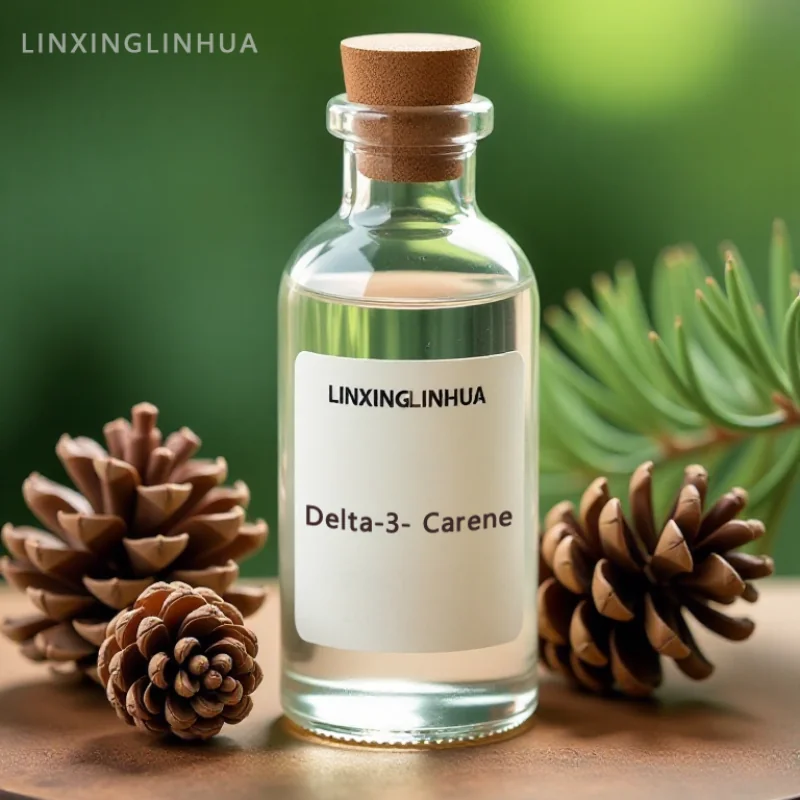
Crude turpentine is not a single compound; it is a mixture of related monoterpenes, including alpha-pinene, beta-pinene, delta-3-carene, limonene, and smaller amounts of terpinolene and sabinene. Fractional distillation of rectified oil of turpentine separates these components by boiling point so each one can be supplied at a defined purity rather than as part of a blended oil. Delta-3-Carene is one of the fractions we isolate this way at our Yunfu facility, and it carries a strong, pine-like aroma that formulators recognize immediately once it’s opened.
Our Delta-3-Carene carries CAS No. 13466-78-9, a molecular formula of C10H16, and a molecular weight of 136.23. It ships as a colorless, transparent liquid with a specific gravity of 0.855 to 0.865 at 20/4 degrees C, a refractive index of 1.4640 to 1.4680, gas-chromatography purity of 95 percent or above, and a flash point of 45 degrees C. We recommend storing and shipping it in a cool, dry, well-ventilated space away from direct sunlight to keep that aroma and purity stable through transit.
Formulators use it across cosmetic and personal care lines for its fresh, piney top note, in flavor and fragrance work as both a natural aroma component and a raw material for synthetic flavorings, in select electronics applications, and in pharmaceutical formulations calling for a natural monoterpene input. Because it occurs naturally within pine essential oils, it also falls under the natural equivalent flavor classification, a distinction some food and beverage formulators need to satisfy labeling requirements without switching to a fully synthetic input.
Why Buyers Source Their Terpenes From Us
We have been distilling pine chemicals since 1998 from the Baishi Industrial Development Zone in Yunfu, Guangdong, a region that sits at the center of China’s gum rosin and turpentine supply and keeps our raw material sourcing close and consistent. With more than 50 staff, our production spans an annual capacity built around 2,000 metric tons of alpha-pinene and beta-pinene, 1,500 metric tons of longifolene, 1,000 metric tons of isolongifolene, 500 metric tons of isolongifolanone, 1,000 metric tons of paracymene and paramenthane, and 1,000 metric tons of terpineol and pine oil, alongside our Delta-3-Carene line.
Since 2019, those lines have run under fully automated PLC control, and our in-house R&D team holds process patents and has picked up several provincial and municipal quality awards along the way. Food, coatings, pharmaceutical, and flavor and fragrance companies across dozens of countries now rely on that consistency batch after batch.
Meeting the Clean-Label Shift at Scale
As more formulators trade petrochemical inputs for plant-derived ones, the same distillation heritage keeps proving its worth, whether a project calls for the broad solvency of rectified turpentine oil itself or a narrow, defined-purity fraction like Delta-3-Carene. Both leave our Yunfu facility under the same quality checks.
We keep stock across that range and can walk a technical team through certificates of analysis, packaging options, and lead times before an order gets placed, whether the destination is a flavor lab, a cosmetics line, or a pharmaceutical formulation bench. If a formulation depends on dependable terpene supply, Linxingpinechem is a straightforward place to start the conversation; reach out with a specification and we will confirm what is available from current production.